Features
Discovery & the Crucible score
The full inventory of installed software, and how Crucible turns each artifact into an explainable 0–100 risk score.
Discovery is the inventory of every extension, package, MCP server, and model found across your fleet, each scored by the Crucible engine. Crucible is the engine that produces those scores.
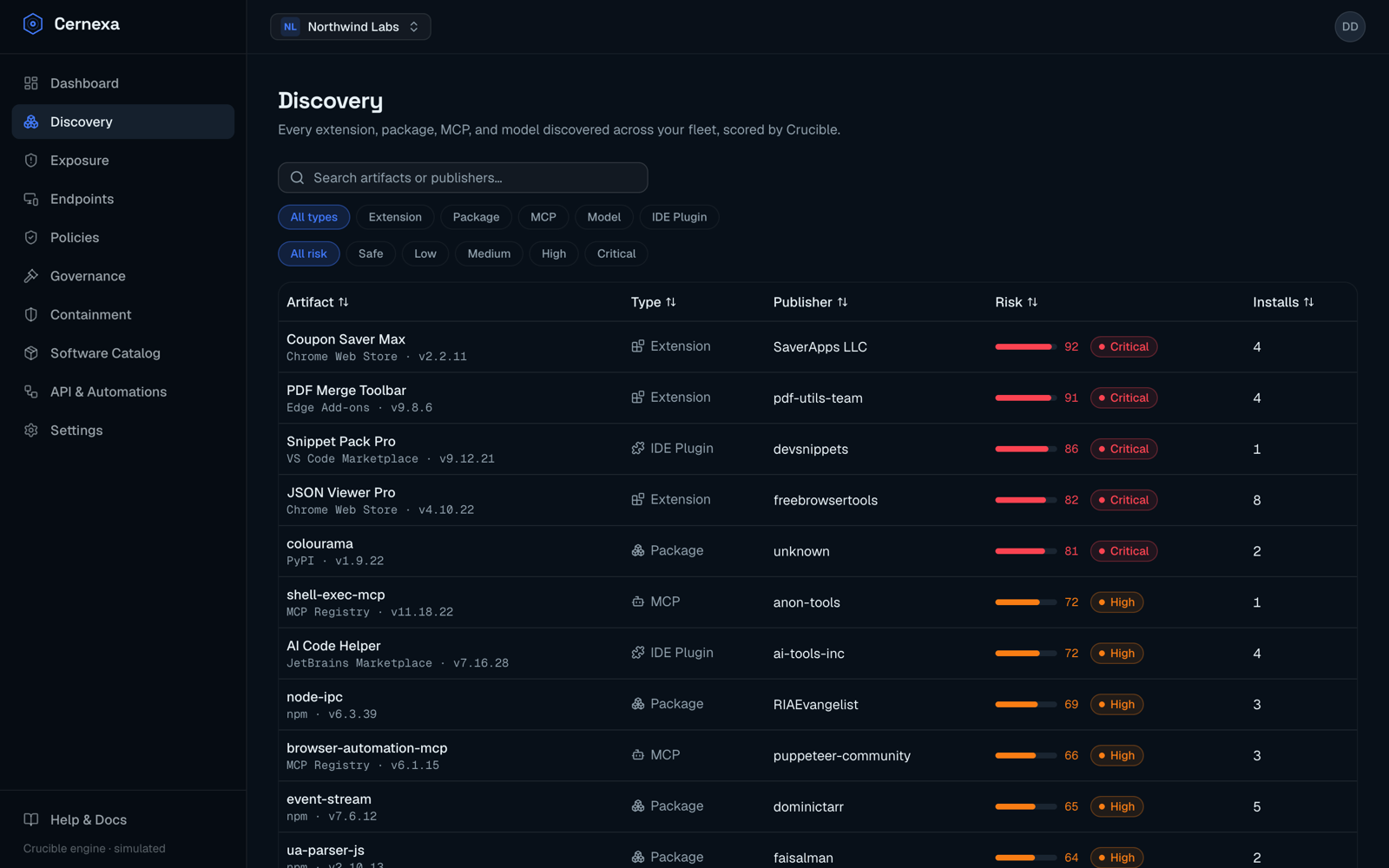
The Discovery inventory
Each row shows the artifact name, its type (extension, package, MCP, model, or IDE plugin), its risk score and verdict, how many endpoints it's installed on, and its publisher. Click any artifact to open its detail page.
The artifact detail page
The detail page is where investigation happens:
- Crucible score — the 0–100 score with a sparkline of its history.
- Crucible risk report — every signal that contributed, each with a severity, a point value, and a plain-language explanation. Protective factors (like a verified publisher) appear as negative points.
- Known vulnerabilities — CVEs in the installed version, with severity, EPSS, and KEV/ransomware flags. See Exposure.
- Publisher — reputation score and verification status.
- Composition — popularity, age, permissions, egress hosts, and whether the code is obfuscated or contains embedded secrets.
- Install footprint — every endpoint the artifact is on. From here you can ringfence it or make an org-wide governance decision.
How Crucible scores
Crucible is deterministic and explainable — the score is an itemized sum of weighted signals, never a black box. Verdicts map from the score:
- Safe 0–9 · Low 10–29 · Medium 30–54 · High 55–79 · Critical 80–100
Signals include:
- Dangerous permissions — broad host access (
<all_urls>), native messaging, debugger, shell/exec, child-process spawning. - Network egress — points per external host the software contacts.
- Embedded secrets — hardcoded credentials or tokens found by static analysis.
- Obfuscated code — packed or obfuscated code that resists analysis.
- Known CVEs — per-CVE points plus a surcharge for the most severe one in the version.
- Active exploitation — extra weight when a CVE is on CISA's KEV list or tied to ransomware; EPSS raises it further.
- Recent ownership change — a publisher takeover within the last 90 days.
- Update volatility — irregular, high-frequency releases that widen the tampering surface.
- Publisher reputation — verified, reputable publishers reduce the score; unverified or low-trust ones raise it.
- Immaturity — very new software with few installs.
Agentic-AI signals (MCP servers)
Because MCP servers hand tools to AI agents, Crucible adds runtime signals for them:
- Auto-approved tool calls — the client runs the server's tools without approval (the primary MCP prompt-injection / RCE vector).
- Fetches & executes remote code — launched via
npx/uvx/pipxorcurl | sh, so it can run different code on each start. - Unpinned version — no fixed version, allowing silent changes between launches.